

What it is
The Plant-Based Nudge Calculator from Better Food Foundation estimates how many meals a dining hall, hospital, coffee shop, or event could shift from animal-based to plant-based in a year, and how much carbon that saves. It covers nudges: changes to how food is offered, such as the default dish or how a dish is described on the menu, that shift what people choose without taking any option away.
You enter three numbers: meals per person per day, days open per year, and people eating there each day. Then you pick a nudge, and the calculator multiplies your numbers by that nudge’s average effect in published studies. It shows meals replaced a year and kilograms of carbon dioxide equivalent (CO2e, the standard unit for comparing greenhouse gases) saved a year. It doesn’t count animals, but the methodology report gives a conversion: multiply meals replaced by 0.087 for a typical US diet, with separate figures for beef-heavy and chicken-heavy menus.
Better Food Foundation researcher Björn Ólafsson built it, with advice from experts including Cass Sunstein, co-author of the book Nudge. The methodology report explains every figure, and the study database lists the studies behind them.
The calculator doesn’t use AI, but Björn built it by having Claude Code write the code, and he and others tested it afterward. That is vibe coding: someone without programming skills has AI write the code while they act as the manager, the tester, and the subject expert. The code, and the changes Claude Code made to it, are public on GitHub.
The five nudges
The effects below are the averages the calculator uses, in percentage points: the rise in the share of diners choosing a plant-based meal. Going from 20% of diners to 70% is a 50-point rise.
| Nudge | What changes | Average effect | Evidence rating |
|---|---|---|---|
| Plant-based defaults | Plant-based is the standard meal, with animal products on request | About 50 points | 4 of 5 |
| Climate-friendly ratios | Two plant-based dishes for every animal-based one | About 0.75 points for each point added to the plant-based share of the menu | 4 of 5 |
| Prime placement | Plant-based dishes go first on the menu or counter | About 5 points | 3 of 5 |
| Subtle substitutions | Plant-based swaps for egg, dairy, and other animal ingredients in recipes | 5 points, an estimate with little data behind it | 1 of 5 |
| Tasty titles and descriptions | Plant-based dishes get names and descriptions that sound delicious | About 12 points | 3 of 5 |
An “Other nudges” option, for changes outside these five, uses the average of placement, substitutions, and titles.
What it’s good at for advocacy orgs
- Choosing which change to ask for. The nudges’ effects differ by a factor of ten. Run one campus’s numbers through two or three of them to see which ask would shift the most meals.
- Making the case for one event. It works for a single event as well as a full year. For a 300-person conference with two days of lunches, a plant-based default with meat on request comes out at 298 meals shifted and 527 kg CO2e saved.
- Reporting a change you have already won. If a cafeteria or caterer has adopted a nudge, the calculator gives a consistent estimate of its yearly effect for a report or grant application. Say which nudge and inputs you used, so a funder can check the sum.
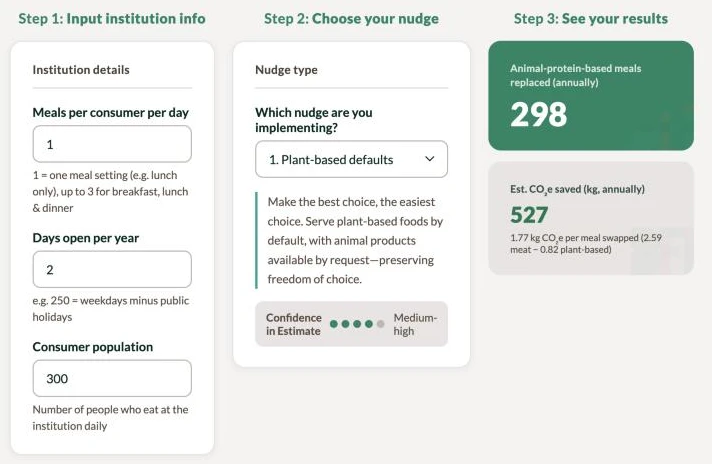
The conference example in the calculator. The evidence rating for plant-based defaults shows as four of five dots.
Where it fits
The calculator estimates how big a change could be. For how to make it happen, Better Food Foundation’s free virtual Nudge Training covers each nudge. To see what studies found in settings like yours, beyond the single average, open the study database or ask the Faunalytics Lens, an AI research assistant from Faunalytics, about the research on plant-based defaults.
Watch-outs
- Treat the results as upper estimates. Most studies behind the numbers compared diners before and after a change instead of assigning them at random, and studies designed that way tend to report larger effects. Better Food Foundation says so in its methodology and doesn’t adjust for it, so call the figures estimates.
- One nudge at a time. Almost every study tested a single nudge, so the calculator can’t combine them. Better Food Foundation suggests using your strongest single nudge as your baseline.
- The carbon figure assumes a typical US meat mix. Every meal replaced counts as 1.77 kg CO2e saved, based on average US meat consumption and a 200 g serving of meat. If your setting serves mostly one kind of meat, or is outside the US, the carbon figure is rougher.
Getting started
- Open the calculator at betterfoodfoundation.org/nudge-calculator.
- Find the three numbers for one setting. Count the people who eat there each day, instead of total enrollment or staff. For a university or hospital, a deep research tool in Claude, ChatGPT, or Gemini can often find published figures. Check them against the sources it cites.
- Choose the nudge you plan to ask for. For climate-friendly ratios, also enter the current and planned plant-based share of the menu.
- To show the carbon figure as cars or homes, use the EPA’s Greenhouse Gas Equivalencies Calculator.
- Use the prompt below to draft a one-page case.
Turning your result into a pitch with AI
Claude, ChatGPT, or Gemini can turn your result into a draft for the person who decides. Give it your inputs and results, and point it at Better Food Foundation’s methodology so it describes the evidence accurately.
I'm preparing to ask [INSTITUTION OR EVENT] to adopt [NUDGE]. I ran Better Food Foundation's Plant-Based Nudge Calculator with these numbers:

- Meals per person per day: [NUMBER]
- Days open per year: [NUMBER]
- People eating there each day: [NUMBER]
- Nudge: [NUDGE NAME, PLUS CURRENT AND NEW PLANT-BASED SHARE IF IT IS CLIMATE-FRIENDLY RATIOS]
- Result: [NUMBER] animal-protein-based meals replaced a year and [NUMBER] kg CO2e saved a year
- Everyday comparison from the EPA Greenhouse Gas Equivalencies Calculator: [PASTE RESULT, OR "NONE"]
- Include an estimate of animals: [YES, FOR A TYPICAL US, BEEF-HEAVY, OR CHICKEN-HEAVY MENU, OR NO]

Source material: Better Food Foundation's methodology report (https://www.betterfoodfoundation.org/wp-content/uploads/2026/08/Nudge-Calculator_-Detailed-Methodology_BetterFoodFoundation_2026.pdf) and calculator page (https://www.betterfoodfoundation.org/nudge-calculator/). Read the report's sections on this nudge and on the carbon and animal estimates, and the page's answers about cost and choice. If you cannot open either source, or can see only a preview or summary, say so and ask me to upload it.

Template or example to follow: [PASTE, UPLOAD, OR POINT TO A CONNECTED FILE; OR "NONE"]

The reader is [ROLE, E.G. "THE DIRECTOR OF DINING SERVICES"]. They care most about [E.G. "BUDGET, STUDENT SATISFACTION, AND THE UNIVERSITY'S CLIMATE TARGET"].

Write a one-page case for the change in plain language:
1. Start with what we are asking for and the estimated meals and carbon each year.
2. If I asked for an animal estimate, use the methodology's multiplier for that menu type and show the sum.
3. Call the numbers estimates. Give the calculator's evidence rating for this nudge, and say the effects come mostly from studies that may overstate them.
4. Answer the objections this reader is most likely to raise, using only what the sources support.
5. Do not invent facts about [INSTITUTION OR EVENT]. Mark anything I need to confirm as [CHECK].

Follow the template if I gave one. Otherwise keep it under 400 words.
Before you send it, check every number against the calculator and rewrite the draft in your own voice.
Pricing snapshot
Free, with no sign-up. Better Food Foundation also runs free Nudge Training sessions and, where it has capacity, helps organizations working at scale model their nudges (contact them). A survey on the calculator page asks how people use it, and the answers shape what Better Food Foundation builds next.
